Olive Dennis
"No matter how successful a business may seem to be, it can gain even greater success if it gives consideration to the woman’s viewpoint."
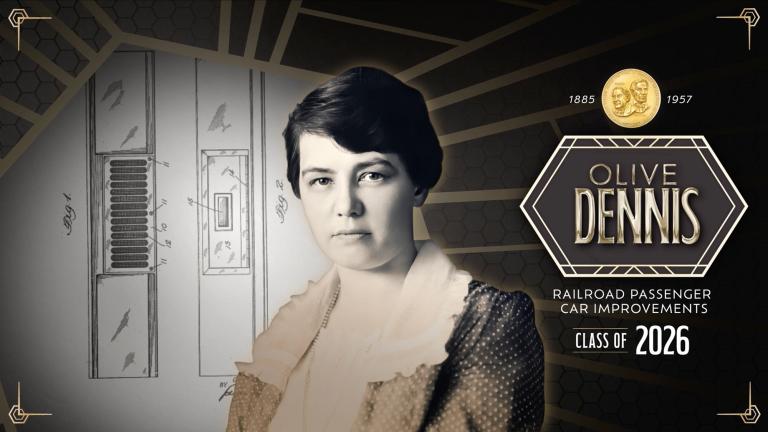
Olive Dennis, a civil engineer for the Baltimore and Ohio (B&O) Railroad Co., made travel vastly more comfortable for rail passengers. Traveling tens of thousands of miles annually for nearly 30 years, Dennis applied both her expertise and her experience to develop many innovations for railroad passenger cars.
Dennis was born in 1885 in Thurlow, Pennsylvania, and she grew up in Baltimore. Her interest in engineering began early in her childhood, and it has been reported that she once said she took to screwdrivers, saws and chisels “as naturally as a duck to water.” Demonstrating her ingenuity and creativity, she built houses and furniture for her dolls and made a model of a streetcar for her younger brother.
After graduating from high school, Dennis earned her bachelor’s degree in mathematics from Goucher College in 1908 and her master’s degree in mathematics and astronomy from Columbia University in 1909. She then took a position with the District of Columbia Public Schools, spending a decade teaching mathematics at McKinley Manual Training School from 1909 until 1919. Still wishing to pursue a future in engineering, she attended two summer sessions of engineering school at the University of Wisconsin and then enrolled at Cornell University, where she earned a degree in civil engineering in 1920.
At the time, women were not expected to pursue engineering careers, and Dennis found it challenging to secure a job. However, when she contacted B&O Railroad, she was offered a position as a designer in the bridge engineering department, making her the first woman hired as a civil engineer by any railroad. Within a year, Dennis was promoted to the role of engineer of service and became the first woman in the U.S. to hold such a position.
Facing increased competition from buses and cars, B&O needed to retain women passengers, who made up a significant share of its ridership. Daniel Willard, B&O president, tasked Dennis with applying her technical expertise to recommend, develop and oversee changes that would address women passengers’ concerns and lead them to choose B&O over competitors. “No matter how successful a business may seem to be,” Dennis said, “it can gain even greater success if it gives consideration to the woman’s viewpoint.”
Dennis rode B&O’s trains, as well as competitors’ trains, to understand the typical passenger’s perspective and to observe all the obstacles and discomforts they might experience. In her first year alone, Dennis traveled over 44,000 miles. Within her first two decades on the job, she covered at least 280,000 miles. Along the way she made note of every problem she saw, and she interviewed fellow passengers. After each trip, she would type up her notes, including her recommendations for improvements and amenities, and provide her reports to Willard.
As she traveled the country, one of the earliest inconveniences Dennis encountered was that ordinary coach seats were too high for shorter riders, including many women, and their feet would dangle without support. She worked with seat manufacturers to replace uncomfortable upright bench seats with individual bucket seats and, later, reclining seats with footrests. Among other advancements, Dennis advocated for large restrooms for women with free paper towels, liquid soap and paper drinking cups. B&O became the first rail company to offer these amenities.
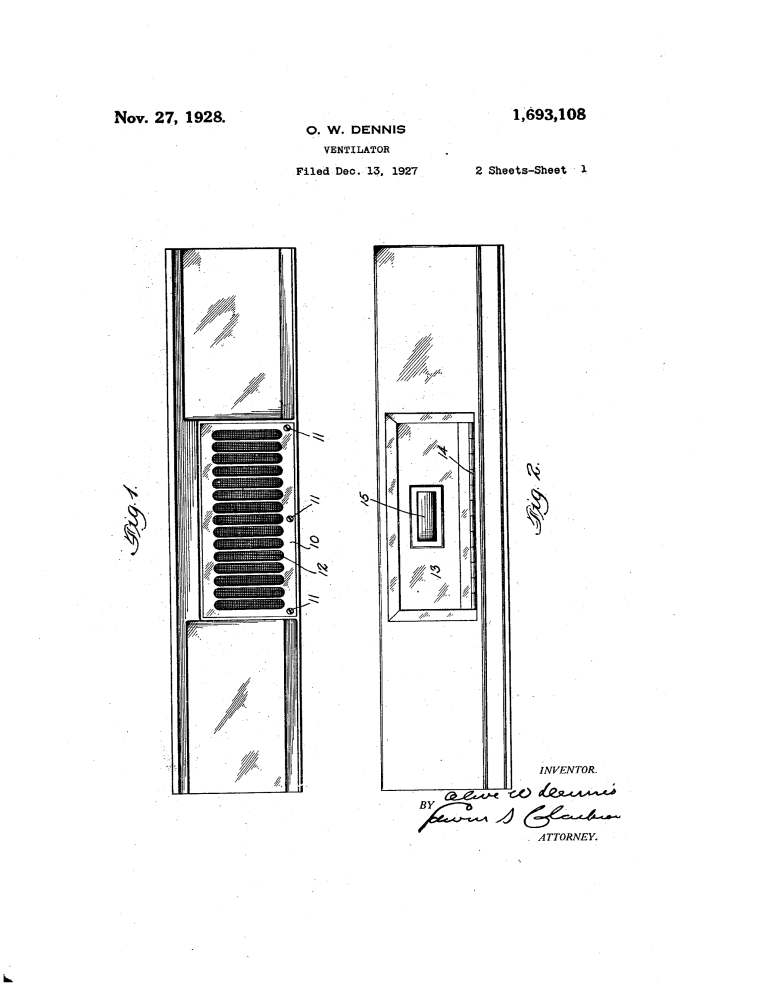
In 1927, Dennis invented an individually operated passenger car ventilator that was built into the sash under each window, allowing fresh air in without causing a draft, even in winter. Through an easily opened and closed shutter, passengers could direct fresh air to their seats without affecting their neighbors. This invention was patented in 1928.
On a visit to St. Louis, Dennis noticed that refrigerator cars were chilled in advance, and this inspired her to begin collaborating with engineers at Carrier Co. (established by fellow National Inventors Hall of Fame® Inductee Willis Haviland Carrier) on an air conditioning system for B&O’s Martha Washington dining car. In 1930, the Martha Washington became the first successfully air-conditioned railroad car. Just one year later, B&O introduced the first completely air-conditioned train, the Columbian. It was so successful, B&O put a second Columbian into service within two months, and air conditioning soon became an indispensable part of comfortable travel.
During World War II, Dennis consulted with the Office of Defense Transportation and co-authored a study on railroad industry jobs that could be filled by women. In 1945, she stepped into the role of research engineer at B&O, where she remained until 1951. In 1947, B&O debuted its luxury streamliner passenger train the Cincinnatian, for which Dennis was the principal designer. She had designed its exterior train covering, the shroud, to allow technicians to easily access the running gear and mechanical parts. She even selected, coordinated and designed everything from the upholstery and carpeting to the printing on the menus. The Cincinnatian earned a reputation for excellence in both comfort and efficiency.
Over the course of her pioneering career, Dennis helped increase B&O’s revenue while making a significant impact on the ways in which the company accommodated its passengers. In addition to making technical advances, Dennis also designed a set of dishes that were used in dining cars on B&O lines. The dishes’ pattern, which featured scenic views along the company’s routes and the machinery that carried its passengers and goods, earned Dennis a design patent. An instant success, these dishes remain emblematic of B&O.
Dennis became the first woman elected as a member of the American Railway Engineering Association in 1927. In 1940, the Women’s Centennial Congress named her among 100 Outstanding Career Women in the U.S. — a list of living American women in careers that would have been impossible for women to undertake 100 years earlier.