Frank S. Greene Jr.
"All successful leaders meet their challenges by starting with a clear vision that creates value for others."
Frank S. Greene Jr. was a pioneering electrical engineer, inventor and entrepreneur in Silicon Valley. He developed high-speed semiconductor memory systems, including the fastest microchip then available for the ILLIAC IV supercomputer. As a leader who recognized the need for greater participation in STEM fields, Greene also was dedicated to mentoring the next generation.
Greene was born in Washington, D.C., in 1938, and he grew up in St. Louis. He earned his bachelor’s degree in electrical engineering in 1961 at Washington University in St. Louis, where he was one of the first Black students. He became the first Black cadet to complete the university’s four-year Air Force ROTC program and joined the U.S. Air Force in 1961. Greene was assigned to the National Security Agency, where his focus was high-performance computers, and he achieved the rank of captain.
Having earned his master’s degree in electrical engineering from Purdue University in 1962 and after completing his military service in 1965, Greene joined the research and development department of Fairchild Semiconductor International Inc. in San Jose, California, becoming one of the first Black engineers in Silicon Valley. While working, he also earned his doctorate in electrical engineering from Santa Clara University in 1970.
At Fairchild, Greene led the project to design the gate arrays and semiconductor memory for the ILLIAC IV supercomputer. Built by Burroughs Corp. for the Defense Advanced Projects Research Agency and housed at the NASA Ames Research Center, this was the first major computer to have an all-semiconductor mainframe memory system, and the first to use parallel processing, in which complex programs are broken into tasks. Used for applications including wind tunnel simulation and seismic studies, ILLIAC IV required 131,072 bits of high-speed memory for each of the machine's 64 parallel processing elements. It also called for thin-film memory, but when that could not deliver adequate performance, Burroughs contracted with Fairchild to develop a solution.
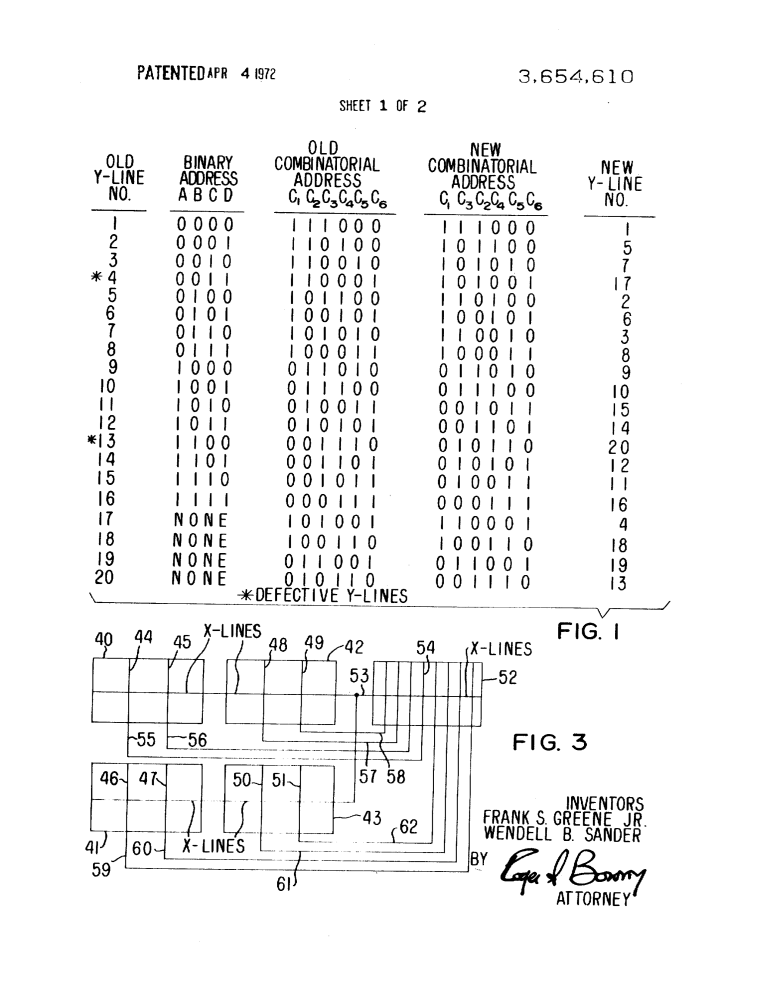
The 256-bit chips used at the time required more than 1,000 microscopic transistors, each of which had to function perfectly. Existing methods for making use of chips with defects were inefficient, so many chips were discarded. Greene collaborated with engineer Wendell Sander to provide an ingenious solution. They co-invented a solid-state RAM device based on arrays that included redundant rows or columns of cells. Information was stored multiple times on the chip, so that any information stored in defective regions also would be repeated in a functioning region.
By allowing imperfect chips to function reliably, this invention, patented in 1972, significantly reduced both waste and chip production costs. Additionally, Greene and Sander’s semiconductor-based 256-bit static RAM chips were the world’s fastest memory chips at the time.
After five years with Fairchild, Greene founded Technology Development Corp. (TDC) in Sunnyvale, California, in 1971. TDC produced automated test and instrumentation systems, and its clients included NASA, the Federal Aviation Administration and the U.S. Navy. By 1984, it had become the largest Black-owned business in Northern California, with about $28 million in sales.
Sharing his expertise, Greene taught courses in computer sciences and electrical engineering at Stanford University, Santa Clara University, Howard University and Washington University in St. Louis. In 1984, when the military electronics portion of TDC was spun off as a public firm, Greene retained ownership of the remaining part of the firm, which changed its name to Zero One Systems. Zero One sold large-scale scientific computer systems to government clients. In 1987, the company was sold to Sterling Software and Greene remained as group president of Zero One until 1989.
Greene also was involved in angel investing and in 1993, he co-founded the venture capital firm New Vista Capital, which specialized in supporting women- and minority-owned businesses. Committed to mentoring young leaders, Greene developed a leadership model he called VRE (vision, relationship, execution), and he founded the Go-Positive Foundation. Through this foundation, he promoted his leadership model to young business professionals and provided scholarships to high school and college students. “All successful leaders meet their challenges by starting with a clear vision that creates value for others,” Greene said.
In addition to making an impact through invention and entrepreneurship, Greene served as the first Black trustee for Santa Clara University and as a board member for the American Musical Theater Board of San Jose. He also was involved in the Alpha Phi Alpha Fraternity, 100 Black Men of Silicon Valley and the San Jose Jazz Society.
In recognition of his influential work, Greene’s honors include the Black Alumni Achievement Award from Washington University in St. Louis in 1991; the Distinguished Engineering Alumni Award from Santa Clara University in 1993; and Purdue University’s Outstanding Electrical and Computer Engineer Award in 1999 and Distinguished Engineering Alumnus Award in 2002. In 2018, Frank S. Greene Jr. Middle School in Palo Alto, California, was renamed in his honor.