Donald Alstadt
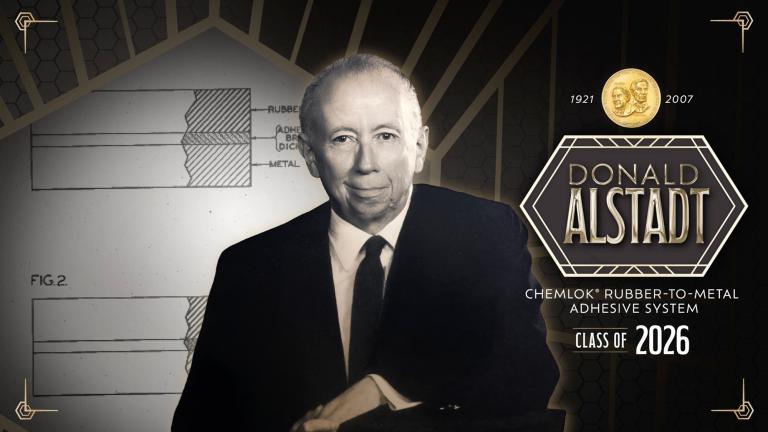
Chemist Donald Alstadt invented Chemlok, a revolutionary rubber-to-metal adhesive system. Chemlok technology is widely used today in the automotive, aerospace, agriculture, off-highway, defense and energy industries.
Alstadt was born in 1921 in Erie, Pennsylvania. After graduating from high school with honors, he enrolled at the University of Pittsburgh. There, he earned his bachelor’s degree in both chemistry and physics in just three years, graduating in 1943. That same year, Alstadt joined Lord Corp., where he would remain until his retirement in 2000.
Lord Corp. was founded in 1924 by patent attorney and inventor Hugh Lord to research and develop solutions to quiet the noise of automobiles. The company produced rubber mountings, including those used in trolley cars made by General Electric Co. When Alstadt joined Lord Corp. in 1943, he began his career as a research chemist. Lord Corp. had already done extensive work relating to the bonding of rubber to metal, especially in its development of aircraft engine mounts used by the Allies during World War II. Thus, Thomas Lord, the son of Hugh Lord and his successor as company president and a longtime company chair, saw in Alstadt a brilliant young chemist whose interests were a perfect fit with what the company's central focus had been.
Engineered rubber-to-metal devices enable key performance attributes for automotive, industrial and aerospace applications. These critical parts rely on a dependable bond between the rubber and the metallic substrate. At the time, existing methods for bonding rubber to metal were inefficient, so in 1950, Alstadt began to investigate the characteristics of adhesion, including surface thermodynamics, polymer structure and the effect of processing variables.
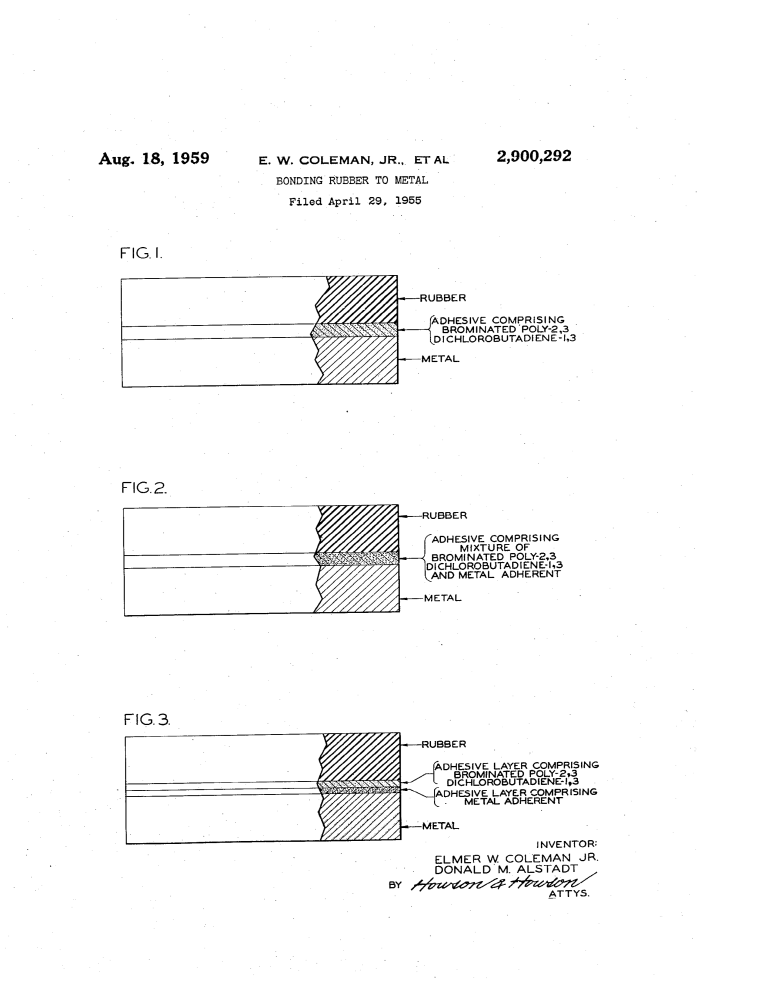
Alstadt led the development of a rubber-to-metal adhesive system using a novel combination of a primer layer and an adhesive topcoat. The primer provides a means of obtaining robust adhesion to the metal while providing the necessary reactivity with the adhesive topcoat. A primer also provides heat- and corrosion-resistant properties that are desirable. An adhesive topcoat is applied to the dried primer, and the topcoat provides a means of reacting with the elastomer backbone during the molding process. The topcoat also reacts with the primer layer so that adhesive and primer intercoat adhesion is achieved.
The patent for Alstadt’s rubber-to-metal adhesive system was filed in 1955 and issued in 1959. It listed a variety of rubber and metal combinations to which the system could be applied. The rubbers included natural and synthetic rubbers, such as polybutadiene, neoprene, polychloroprene and brominated butyl rubber. Each type of rubber could be bonded to any common structural metal, like iron, steel, stainless steel, lead, aluminum, copper, brass, bronze or nickel.
Lord Corp. began marketing Alstadt’s product under the name Chemlok in 1956. In 1960, Lord Corp. became an international company as it took the Chemlok brand worldwide. The product’s subsequent formulations included a variety of water-based and solvent-based mixtures that could be applied in a wide array of industries and could withstand harsh environments, extreme temperatures and high pressures. In 2009, the American Chemical Society’s Rubber Division named Chemlok one of the innovations that shaped the rubber industry, and today, almost every vehicle in the world uses Chemlok or a Chemlok-derived technology.
Alstadt became president of Lord Corp. in 1968, and then became chair and CEO in 1972. He also served on national boards and committees dedicated to promoting research collaborations between academia and industry, and improving America’s competitiveness through innovation. In recognition of his impact, he received honorary doctorates from Allegheny College, Thiel College and Edinboro University.
In 2019, Lord Corp. was acquired by Parker-Hannifin Corp., and this sale generated $261 million each for the Cleveland Clinic, Duke University, the Massachusetts Institute of Technology and the University of Southern California. The distribution plan had been developed by Alstadt and Thomas Lord to benefit research institutions that would carry forward Lord Corp.’s legacy across the country.
After Alstadt passed away in 2007, his wife Judith continued to contribute to academic endowments and workshops. Discussing a gift to the California Institute of Technology to establish the Don Alstadt Workshop and promote greater participation in STEM, Judith Alstadt said, “Education was a burning issue for Don. He was constantly learning, and he thought he could learn something from just about everybody.”