Charles Thiel
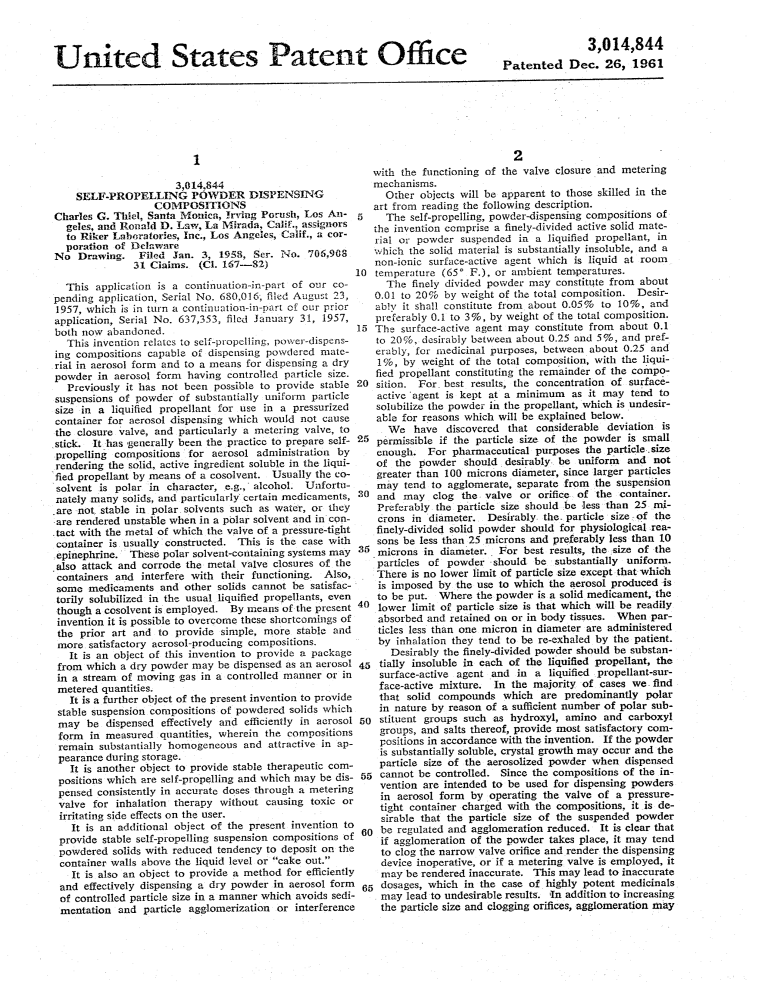
Charles Thiel, George Maison and Irving Porush invented the first pressurized metered dose inhaler (MDI) for the management of asthma and other lung conditions. Introduced by Riker Laboratories in 1956, the MDI was quickly accepted as the first convenient, portable inhaler to effectively deliver medication to the lungs. This important device has saved lives and improved the quality of life for hundreds of millions of people.
Thiel was born in Santa Barbara, California, in 1928. He served in the U.S. Army Air Forces as a military photographer and was stationed in Japan. At the University of California, Santa Barbara, he earned his bachelor’s degree in chemistry in 1954. He then began his long career as a research chemist at Riker Laboratories, a wholly owned subsidiary of Rexall Drug Co.
At Riker, Thiel worked with Maison, who became the company’s president in 1955, and Porush, who was Riker’s head chemist at the time. Maison’s 13-year-old daughter Susie asked her father if the medication she needed to manage her asthma could be delivered in a spray like hairspray. Like many asthma patients, Susie had to depend on a fragile, inconvenient nebulizer, and they were determined to develop a more efficient, user-friendly solution.
After Porush consulted with Rexall’s cosmetics laboratory that provided information about aerosol equipment, propellants and supplies, he soon developed an MDI prototype using soda bottles and chlorofluorocarbon refrigerants. He worked to refine the design, adapting a metered dose valve and more suitably sized plastic-coated glass containers, and then the three colleagues recruited help from a plastics company to make a mouthpiece. Formulating a medication solution that would work with this new device, Porush used epinephrine or isoproterenol — drugs that swiftly would open an asthma patient’s airways and make it easier for them to breathe — and then Thiel took on the challenge of ensuring that the medication could be delivered effectively in the form of a spray.
To accomplish this, Thiel used an innovative suspension of the medication in a liquefied gas propellant. “When you fired it from the mouthpiece, a beautiful, dry fog came out,” he recalled. This method would greatly increase the amount of the drug that would be delivered through the MDI to the user’s lungs.
Together, Thiel, Maison and Porush had developed an innovative device that consisted of a reservoir with a mixture of medication and liquefied gas propellant; a metering valve to facilitate delivery of a specific amount of the reservoir’s contents; and a spray actuator to control atomization of the drug. When the valve was pressed, the metered dose of the drug was ejected and flowed into the valve stem. At the spray actuator, it was atomized and released as a fine aerosol plume.
In June 1955, the MDI was tested for safety, and in early 1956, clinical research was published that showed that it was reliably effective, with the majority of patients experiencing excellent symptom relief. The rescue inhaler was approved by the Food and Drug Administration in March 1956, making it the first such device to receive approval for use by asthma patients.
The MDI was marketed as the Medihaler, with two versions available: Medihaler Epi containing epinephrine and Medihaler Iso containing isoproterenol. Representing a major advance in asthma management, the Medihaler’s small, portable and easy-to-use design offered rapid relief from respiratory distress. The MDI became essential for treating other lung conditions, including chronic obstructive pulmonary disease, and it later inspired many additional technical and pharmacological innovations. In the mid-1960s, Thiel created a technique using high-speed flash photography to capture images of MDI plumes, making it possible to identify defects. Thiel’s technique was adopted widely by industry product developers.
Reflecting on his impact, Thiel recalled a rewarding moment when, after giving a lecture, he was approached by a physician who had been managing asthma since childhood. Thiel said the physician hugged him and said, “If it hadn't been for your invention, I'd be dead.” In 2014, it was reported that more than 2,000 people were taking doses from an MDI every second. In 2020, in the U.S. alone, an estimated 144 million MDIs were sold, and in 2021, the global MDI industry was valued at $16.3 billion. Its value was expected to increase to $22.1 billion by 2031.
Riker Laboratories was purchased by 3M Corp. as a subsidiary in 1970, and in 1991 it was integrated into 3M as the Pharmaceutical Division. 3M would later sell its drug delivery business to Altaris Capital Partners and a new company, Kindeva Drug Delivery, would be formed. Thiel retired in 2000, after 46 years in the field. “Working at a place like 3M, I was never bored and had the creative freedom to try new things,” Thiel said. “People asked me, ‘Why did you stay so long?’ I said, ‘It was hard to leave. 3M provided a beautiful laboratory and paid me to play in it.’”
In 2017, Thiel received the inaugural Jacob Bigelow Award from U.S. Pharmacopeia (USP) for his contributions to the Aerosols Expert Committee and for his contributions to the USP Advisory Panel on Aerosols, where he worked on standards development. In 2006, the Virginia Commonwealth University School of Pharmacy established the Charles G. Thiel Award for Outstanding Research and Discovery in Respiratory Drug Delivery. This award was originally endowed by 3M Drug Delivery and is now sponsored by its successor, Kindeva Drug Delivery. Thiel was the award's first recipient.