Irving Porush
Irving Porush, George Maison and Charles Thiel invented the pressurized metered dose inhaler (MDI), the first portable inhaler that could effectively deliver medicine to the lungs to manage asthma and other conditions. The MDI rapidly gained acceptance, saving lives and improving quality of life for hundreds of millions of patients.
Porush was born in Newark, New Jersey, in 1917. He studied chemistry at the University of California, Los Angeles, where he earned his bachelor’s degree in 1939. He then earned his master’s degree in meteorology from the California Institute of Technology in 1941.
From 1940 through 1946, Porush served in the U.S. Army Air Forces. He served as a weather officer, providing weather information to pilots who were ferrying bombers across the Atlantic Ocean for the British during World War II. Porush received commendations from the Secretaries of Commerce and War for providing timely hurricane information that saved lives and minimized the loss of property in 1944.
After leaving active duty as a lieutenant colonel in 1946, Porush worked as an industrial chemist for four different companies before joining Riker Laboratories, a wholly owned subsidiary of Rexall Drug Co., as a product development chemist in 1951. He would later become Riker’s head of analytical research, head of product development and then director of quality assurance.
It was at Riker Laboratories that Porush began working with Thiel, a chemist, and Maison, the director of research and development who would become president of the company in 1955. The impetus for their co-invention of the MDI came from a conversation Maison had with his daughter, 13-year-old Susie Maison. Susie had asthma, and she depended on a type of nebulizer that was both inconvenient and fragile. Like other asthma patients of the time, she needed an easier, more user-friendly solution, and she had asked her father if her asthma medication possibly could be delivered in a spray, similar to aerosol cans of hairspray.
Porush, Maison and Thiel began to explore this new idea. After consulting with Rexall’s cosmetics laboratory that provided information about aerosol equipment, propellants and supplies, Porush soon developed an MDI prototype using glass Coca-Cola® bottles and chlorofluorocarbon refrigerants. He then refined the design, adapting a metered dose valve and more suitably sized plastic-coated glass containers, and the team worked with a plastics company to create a mouthpiece.
For the medication that would be dispensed through their new device, Porush formulated solutions using epinephrine or isoproterenol, drugs that rapidly open patients’ airways and make it easier to breathe. Thiel then created an innovative suspension of the medication in a liquefied gas propellant, increasing the amount of the drug that would be delivered to the lung.
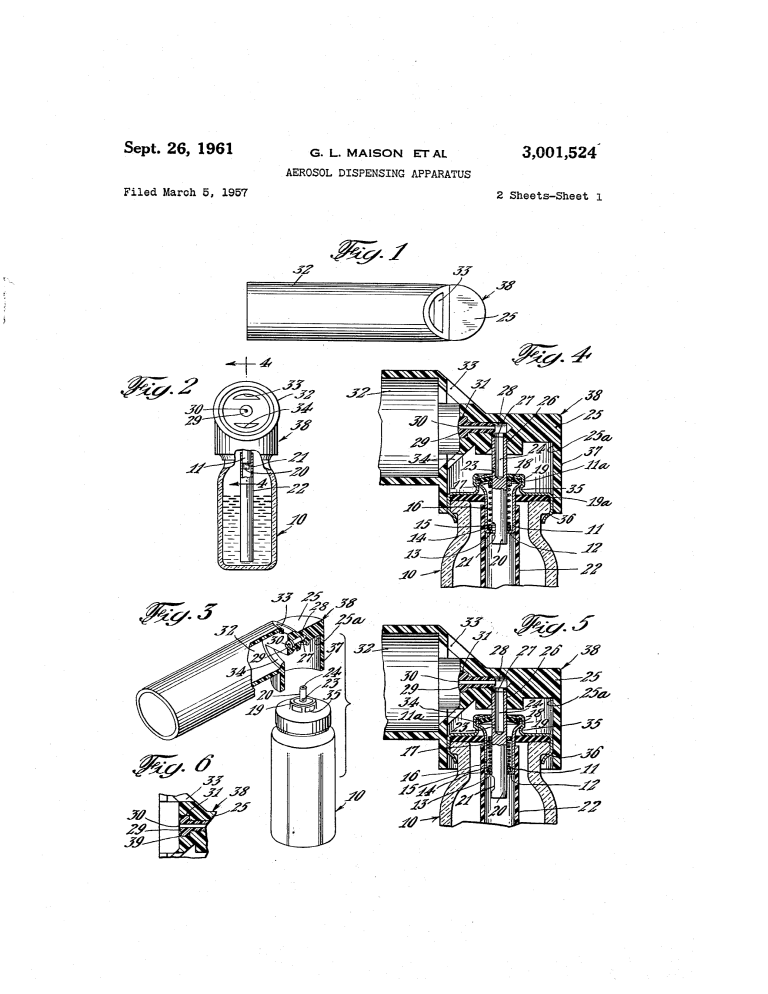
The trio’s finished inhaler design consisted of a reservoir with a mixture of medication and liquefied gas propellant; a metering valve to facilitate delivery of a specific amount of the reservoir’s contents; and a spray actuator to control atomization of the drug. When a patient pressed the valve, a metered dose of the drug would flow into the valve stem, and when it reached the spray actuator, it was atomized and released as a fine aerosol plume capable of penetrating through the mouth and throat and reaching the patient’s lungs.
The MDI was first tested for safety in June 1955. In early 1956, clinical research was published that demonstrated its effectiveness, with the majority of patients experiencing excellent symptom relief. Described as a rescue inhaler, the MDI was approved by the Food and Drug Administration in March 1956, making it the first such device to receive approval for use by asthma patients.
Riker Laboratories marketed the MDI as the Medihaler and offered two versions for different medications — Medihaler Epi with epinephrine and Medihaler Iso with isoproterenol. The device provided asthma patients with nearly instant relief from respiratory distress in a small, portable, easy-to-use and highly effective system. It also became essential for treating other lung conditions, including chronic obstructive pulmonary disease. The invention also inspired many more technical and pharmacological innovations. In 2014, it was reported that more than 2,000 people were taking doses from an MDI every second. In 2020, in the U.S. alone, an estimated 144 million MDIs were sold, and in 2021, the global MDI industry was valued at $16.3 billion. Its value was expected to increase to $22.1 billion by 2031.
After 31 years at Riker Laboratories, Porush retired in 1982. Following his retirement, he was active for many years as a consultant to pharmaceutical businesses. He also was a mediator for disputes between investors and their investment companies.