Reuben Trane
Mechanical engineer Reuben Trane began making advancements to heating and cooling technologies early in the 20th century, providing reliable comfort for homes and commercial buildings around the world. With his innovations and business leadership, The Trane Co. became an industry giant. More than a century later, the brand remains a leader.
Trane was born in 1886 in La Crosse, Wisconsin. His father, James Trane, was an immigrant from Norway. After Trane graduated from high school, he spent a year working as a plumber’s helper at the plumbing company his father had established.
In 1906, Trane entered the University of Wisconsin-Madison to study engineering. To support himself as he continued his education, he worked as a waiter and a furnace tender, and at the same time, he excelled in athletics and his many other extracurricular activities. He graduated with a bachelor’s degree in mechanical engineering in 1910.
After earning his degree, Trane once again worked for his father’s plumbing and heating business. Then, on April 5, 1913, he joined his father and his sister Stella Trane in establishing The Trane Co. to manufacture steam heating system components, including the steam valves, traps and pumps used in the low-pressure steam vapor heating system that James Trane had originally designed.
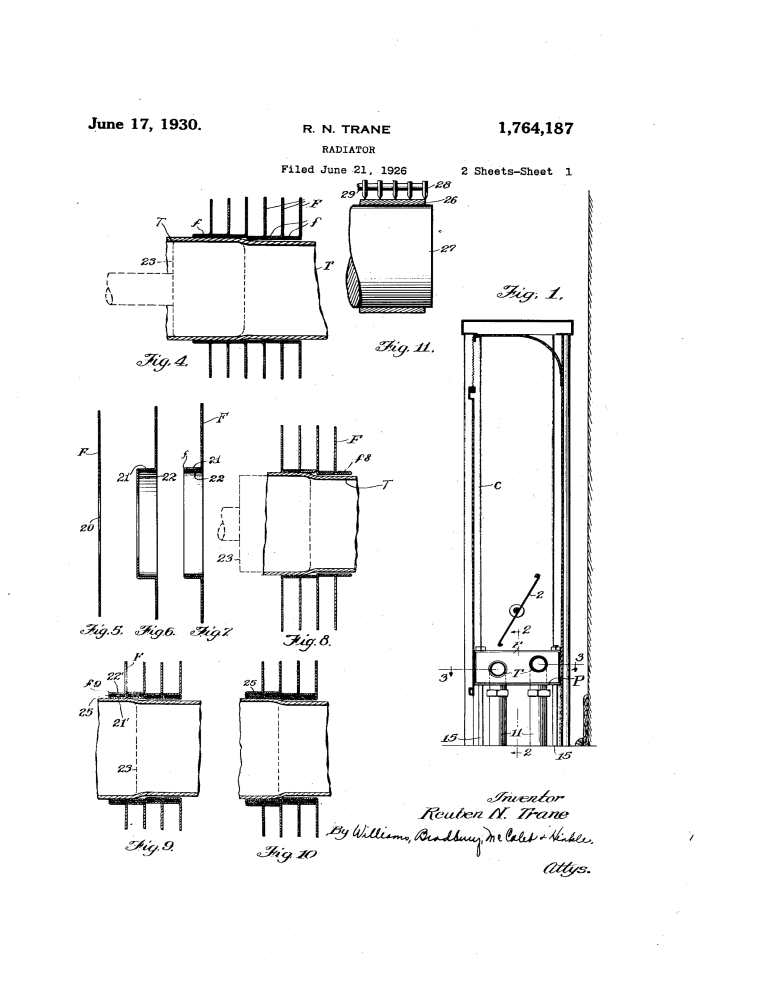
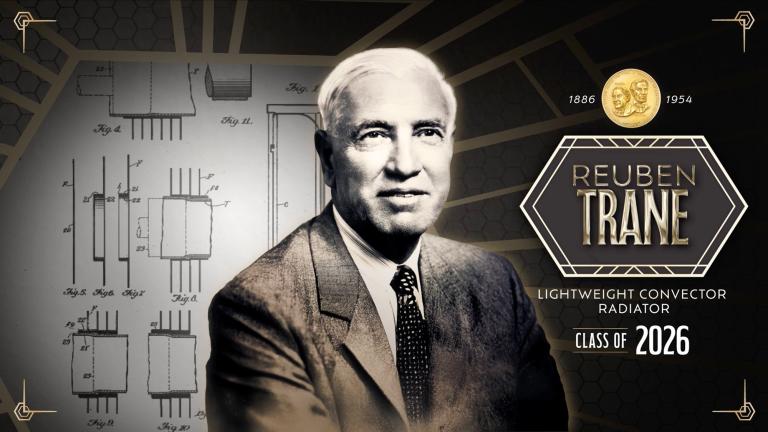
Having sold and installed steam heating accessories for cast iron radiators, Trane recognized their many drawbacks. Laboring in the corner of their new factory in the 1920s, he started working on a new heat exchanger to replace the bulky cast iron radiator. He began experimenting with copper to take advantage of its superior heat transfer and lighter weight. In 1926, The Trane Co. announced the Heat Cabinet, featuring the “tube-and-fin” convector-radiator coil, in a special six-page advertisement in the April 17 issue of Domestic Engineering Magazine. Its extended-surface heat transfer coil provided a large surface area of fins coupled to tubes through which heating fluid would flow.
The advertisement included a thought-provoking statement describing this invention as so revolutionary that its “far reaching effects on modern heating are beyond comprehension.” The convector-radiator was the first modern coil used for heat exchange between two fluids, such as water and air. The coil would become the heart of an entirely new line of heating equipment that would propel The Trane Co. to a leadership position in the heating industry.
The Trane Heat Cabinet quickly gained popularity. With its energy efficiency and smaller size, it was ideal for use in homes and businesses, and architects embraced the model for use in new construction. By 1930, The Trane Co. had built a second manufacturing facility to keep up with the demand for the Heat Cabinet convector. Trane also had established offices in England, Canada and Belgium, and its distribution network encompassed branches in 28 states, Washington, D.C., seven Canadian provinces, China and Japan.
The Trane Co. also became a pioneer in the air conditioning industry. In 1935, the company introduced the first cooling system that used refrigerant. Following the 1938 introduction of the Turbovac, the first hermetically sealed, centrifugal refrigeration machine, The Trane Co. increasingly focused on air conditioning. In 1951, the company unveiled the CenTraVac® chiller, which could automatically start, stop and run while adjusting its power usage to meet changing cooling requirements.
Trane’s innovations also made an important impact during World War II. By the end of the war, The Trane Co. had supplied more than 1 million products in support of the U.S. and its allies. The company’s heat exchange equipment could be found in aircraft and naval ships, and throughout U.S. Army and U.S. Navy bases, hospitals and factories.
As The Trane Co.’s president and board chair, Trane believed that research and development were critical to the company’s success. Founded on innovation and technology leadership, it grew rapidly, from $50,000 in sales in 1913 to over $45 million in 1953. Trane deeply valued the expertise of his team, saying, “If the choice were mine, I’d rather lose my business but keep my engineers together.” Trane also was committed to philanthropy and public service in La Crosse, which for decades was home to his company’s headquarters and primary manufacturing facilities. He was active in many fundraising drives, most notably for the La Crosse Home for Children.
The memorable tagline “It’s Hard To Stop A Trane” was introduced in 1992 to reinforce the brand’s reliability and durability, and it remains widely used. In 2008, the company was acquired by Ingersoll Rand Inc. for more than $10 billion. In 2020, following the spin-off of Ingersoll Rand’s Industrial segment, the remaining climate-focused company launched as Trane Technologies. Today, Trane Technologies is widely recognized as a global climate innovator and sustainability leader. Through its strategic brands Trane® and Thermo King®, its innovative portfolio of solutions and more than 45,000 engaged employees, the company delivers sustainable, efficient heating and cooling solutions and services for buildings, industry, homes and transportation around the world.