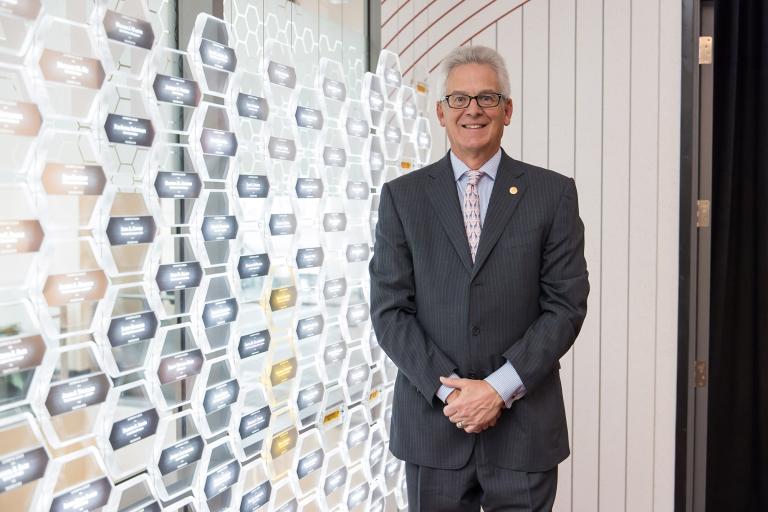
Michael Morykwas
"We just created an environment that's much more conducive to healing."
Michael Morykwas and Louis Argenta developed Vacuum Assisted Closure (V.A.C.). This revolutionary medical device uses controlled suction to draw excess fluid from a wound, enable its closure and healing, and encourage new tissue growth. V.A.C. therapy has been used to help millions of patients worldwide by treating a wide range of difficult-to-heal wounds, including traumatic wounds sustained by military personnel.
Morykwas was born on May 2, 1956, in Detroit, and he spent most of his childhood in Muskegon, Michigan. There, he grew up exploring nature and discovering his love of tinkering. “I'm the kid who took the lawnmower apart and put it back together,” Morykwas said as he reflected on his childhood in an interview with the National Inventors Hall of Fame®. “I just enjoyed tinkering and figuring stuff out.” He also learned the value of work at a young age, explaining that his parents taught him “if you wanted something, you had to work for it.”
When Morykwas enrolled at Michigan Technological University, he was initially a pre-dental student. However, three years into dental school, he decided to change paths when he realized he was increasingly interested in biomaterials. At the University of Detroit, he earned his bachelor’s degree in biology in 1981, and at the University of Michigan, he earned his master’s degree in 1983 and his doctorate in 1988, both in bioengineering.
In 1988, Morykwas was one of the first hires Argenta made for his new department of plastic surgery at Wake Forest University – a department that since has become one of the leading plastic surgery programs in the U.S. Morykwas later described Argenta as “one of the more honorable people [he’s] ever met.”
At Wake Forest, Argenta specialized in treating the most challenging cases, and one of these cases led him to begin developing the idea behind the V.A.C. system. In late 1988, he had a patient with a serious wound that had become infected and could not be sutured, and he began to think about trying to create a vacuum apparatus that could safely pull the wound together. When Argenta brought this initial idea to him, Morykwas immediately began constructing a prototype.
The co-inventors began testing their work on a swine model, so that they could determine the effects of subatmospheric pressure on blood flow in the wound area, and its effect on the formation of granulation tissue – an important step in the healing process. Within days, they saw that blood flow and granulation tissue growth increased significantly, and at the same time, the levels of bacteria decreased. Later, in a study involving 300 human patients, 296 experienced favorable wound healing following V.A.C. treatment.
The V.A.C. wound care system includes an open-cell foam dressing, a semipermeable adhesive cover, a fluid collection system and a suction pump. It treats open wounds by applying either continuous or intermittent subatmospheric pressure to the wound surface, and it promotes healing by pulling the wound’s edges together with evenly distributed suction. It also effectively removes excess fluids and infectious materials, reducing the risk of infection.
“You turn the vacuum on and because it's an open-cell foam, it shrinks, and that pulls on all the surrounding tissue. When you apply a force to a tissue, it grows. The cells will divide, and it'll grow. And when you relieve the pressure by removing the fluid, that helps restore the blood flow,” Morykwas explained. “We just created an environment that’s much more conducive to healing and cell growth.”
V.A.C. was certified by the Food and Drug Administration in 1995, and the patent was issued to Wake Forest University in 1997. Wake Forest licensed the V.A.C. to Kinetic Concepts Inc. (KCI) in 1993, and patent royalties for the university were in the hundreds of millions of dollars. For KCI, V.A.C. revenue reached nearly $500 million by 2004, and it later became a billion-dollar product line. KCI was renamed to Acelity in 2015, and in 2019, 3M Corp. acquired Acelity for $6.7 billion. In 2023, it was announced that 3M would spin off its healthcare business, including Acelity, into a new company, Solventum.
Considered one of the most important advances in wound treatment in the past 50 years, the V.A.C. has been applied across a wide range of clinical situations to treat more than 20 million patients whose wounds would have otherwise not healed or might have healed over very long periods. Nearly all U.S. military personnel with traumatic extremity wounds in Afghanistan and Iraq returned to the United States with the V.A.C. in place.
Discussing his work, Morykwas said, “I just worked hard, and I had some creativity and some ability to recognize others’ creativity and expand on it.” In 2015, Morykwas and Argenta received the Medallion of Merit, Wake Forest University’s highest honor. In 2017, the co-inventors founded Renovo Concepts Inc. to develop devices for treating brain and heart injuries. Morykwas serves as president and chief science officer at Renovo. He also has served on the board of directors for the National Multiple Sclerosis Society and on the boards of charitable organizations in the Winston-Salem, North Carolina, area.