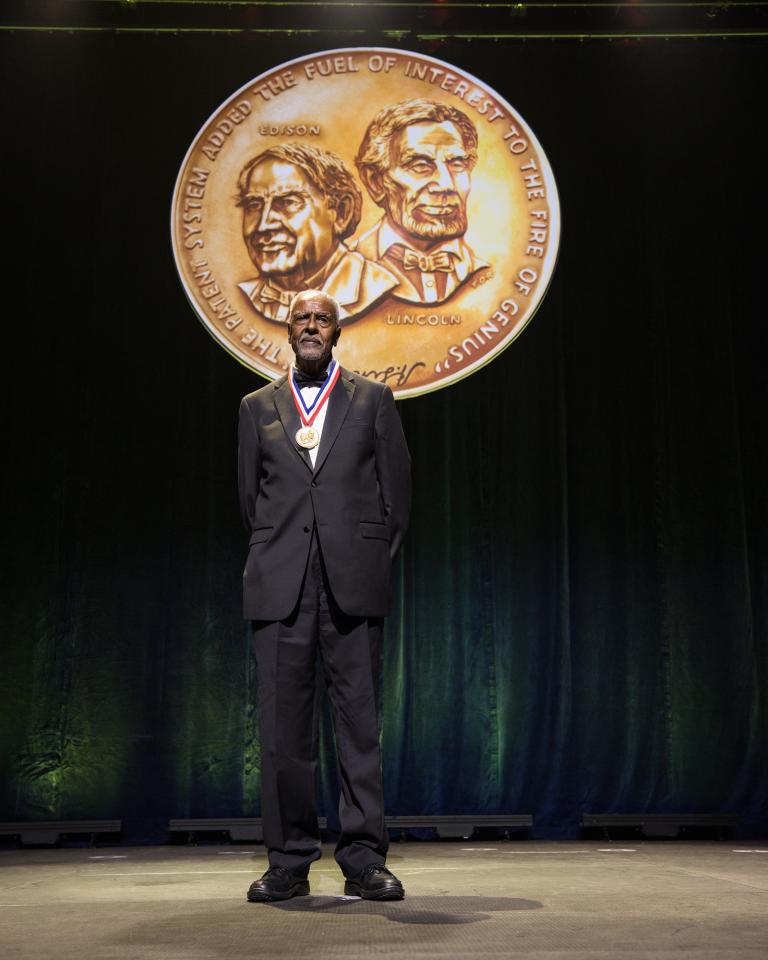
Gebisa Ejeta
"I did the best of my ability to provide service to humanity."
Plant geneticist Gebisa Ejeta developed higher-quality sorghum hybrids that are resistant to drought and disease. By increasing the production and availability of sorghum, a versatile and important cereal grain, Ejeta’s efforts have helped feed millions of people across Africa and around the world.
Ejeta was born June 1, 1950, in the village of Wollonkomi in west-central Ethiopia. In this small farming community, he grew up in a one-room, thatched hut with a mud floor. To ensure he could rise beyond the poverty and food insecurity of his youth, Ejeta’s mother, Moto Ayana, was determined to provide him access to education. Speaking about his mother in an interview with the National Inventors Hall of Fame®, Ejeta said, “She sacrificed an awful lot to make sure I got a basic education. And this was coming from a woman who had not received any education. She believed in the value of education.”
When Ejeta’s mother arranged for him to attend a school in a neighboring town, he walked over 12 miles every Sunday afternoon to reach the school. He boarded with other students through the week, then walked back home each Friday. This was his routine through his elementary school years. An excellent student, Ejeta passed a national exam qualifying him to enter high school at age 14, and he chose to attend an agricultural boarding school, the Jimma Agricultural and Technical School, which had been established in Ethiopia by Oklahoma State University. After graduating with distinction, Ejeta attended Alemaya College, which also had been established by Oklahoma State.
In 1973, Ejeta earned his bachelor’s degree in plant sciences, and he was introduced to Purdue University’s John Axtell, a renowned sorghum researcher. Axtell invited Ejeta to assist him in his research, and he later encouraged him to pursue graduate studies in plant breeding and genetics at Purdue. Ejeta did just that, earning his master’s degree in 1976 and his doctorate in 1978. He then joined the International Crop Research Institute for the Semi-Arid Tropics (ICRISAT) branch in Sudan.
Sorghum research is essential because globally, more than half a billion people depend on sorghum as a staple food crop. Not only is it a nutrient-packed food for humans, but it also is used to feed livestock. Though it often is grown in hot, dry areas, it has been susceptible to drought and vulnerable to infestations of Striga, the parasitic weed that had been one of the greatest biological threats to Africa’s food production.
At ICRISAT in Sudan, Ejeta focused on creating hybrid drought-tolerant, high-yielding sorghum varieties, and his work led to Hageen Dura-1 (HD-1). Field trials showed that HD-1 produced 50% to 100% more grain than traditional sorghum varieties. In 1983, HD-1 was distributed to Sudanese farmers, and to ensure its adoption, Ejeta got involved in farmer education programs and established project management structures for certification, monitoring, processing and production. In addition to bringing significant gains in crop productivity, Ejeta’s hybrids also became the catalyst for a commercial sorghum seed industry in Sudan. “I never had an ambition to make money,” said Ejeta, “but if I were going to get into a business, it would be a seed business, because it is something you can do well while you do good."
In 1984, Ejeta returned to Purdue, where he joined the faculty and continued his research. In the early 1990s, he developed NAD-1, which tolerated drought conditions in Niger and generated grain yields that were four to five times higher than the nation’s traditional sorghum production. At the same time, Ejeta generated more than 70 breeding lines for the U.S. commercial sorghum seed industry, elevating both domestic and international markets.
Through his collaborative research efforts, Ejeta made another breakthrough when he found that Striga infestations could be prevented by disrupting sorghum’s chemical signals. He further identified genotypes associated with the production of altered signals for both resistance against Striga, and greater potential for high yields and widespread adaptation. By combining techniques in agronomy, biochemistry and genetics, and with financial support from private and federal sources, Ejeta and his colleagues successfully transferred genes for Striga resistance into local high-yielding sorghum varieties.
In the early 2000s, Ejeta developed an integrated Striga management program, combining Striga resistance with soil-fertility enhancement and water conservation to help farmers in regions where environmental challenges had resulted in reduced crop yields. The program also aimed to create markets for sorghum and provide incentives for farmers to use integrated management. With support from federal agencies, Ejeta introduced the program to farmers in Ethiopia, Eritrea and Tanzania. By 2005, more than 100,000 farmers had adopted Striga-resistant sorghum varieties, and in areas where Ejeta’s integrated management system had been applied, fields were Striga-free and yields increased by as much as five times.
In 2009, Ejeta was awarded both the World Food Prize and his home country’s highest honor: the Ethiopian National Hero Award. With his World Food Prize funds, Ejeta established an educational foundation to support Ethiopian and other African children. In 2023, he was awarded the National Medal of Science. At Purdue University, Ejeta served until his retirement in 2025 as a distinguished professor of plant breeding and genetics and as executive director of the Purdue Center for Global Food Security.
When asked what makes him proudest, Ejeta answered, “To be told that I’ve fed millions. The fact that things I have done continue to provide food and nourishment to millions in Africa meant a great deal to me, because I was poor as a little child. I know what hunger is.” He continued, “I had been given opportunities and received a good education, and with that, I did the best of my ability to provide service to humanity.”