Promote Critical Thinking in the Age of AI
Trends in STEMDate July 15, 2026
Est. Reading Time 5 mins
Innovation is more than a skillset for the future – it’s a mindset for today. While technology is a mainstay in education, could an evolving landscape of instant answers set back learners? Amid the growing presence of artificial intelligence (AI), educators are finding practical strategies to promote critical thinking and highlight the importance of intellectual property.
Read on to learn how invention education is helping school districts strike a balance between embracing broadening applications of AI and emphasizing the value of student creativity.
The Instant-Answer Trap
With screens at their fingertips, the next generation of tech-savvy learners interact with technology on a day-to-day basis. Students are developing digital literacy with a backdrop of rapidly advancing technology. While they have ready-made access to information, it’s important for young learners to participate in the active learning processes.
Rather than defaulting to generated summaries and answers, teaching children to compare and analyze primary sources, develop their own judgment and reframe AI as a starting point helps them stay curious and experimental. If students perform less problem solving during their early years of cognitive development, they could compromise their readiness to create the world they want to live in.
True learning takes place during the process of arriving at answers and the metacognition that sharpens critical thinking. If learning is about finding answers, then teaching persistence and goal setting changes how we view effort. From career exposure to communication and collaboration, students thrive when they use curiosity as their compass to explore.
In the age of AI, critical thinking and a resilient, growth mindset are essential. Guiding students to build the skills that instant answers can’t teach, invention education experiences spark curiosity, experimentation and self-led discovery.
Sparking Imagination With Invention Education
Invention education is a pedagogy that challenges students to find solutions to real-world challenges through experimenting, prototyping and STEM exploration. This approach to active learning encourages children’s natural creativity and guides them through the act of hands-on invention to develop the mindset and skills they need to reach their potential. For more than 35 years, the National Inventors Hall of Fame® has provided trusted invention education programs — including Camp Invention®, Invention Project® and Club Invention® — to schools and districts across the country. As technology and trends evolve, the Hall of Fame’s approach to invention education remains relevant and vital for students and teachers. These programs are designed to meet learners where they are, leverage their curiosity and empower their ideas as they engage in hands-on STEM challenges.
Rather than focusing on instant answers and perfect outcomes, this approach to learning invites children to explore, experiment and develop their own solutions through the process of invention. From ideation to prototyping, these experiences help learners to prioritize sequential steps to bring their ideas to life and learn from setbacks along the way.
As young learners emerge as capable creators, outdated habits of memorizing answers or reducing errors become obsolete. Rather than settling for their first answer, children learn to test ideas and improve upon them with each iteration. With growing confidence and resilience, invention education creates an academic pathway to developing these lifelong skills through tangible experiences that reinforce the value of original ideas.
The I Can Invent Mindset
At the core of every National Inventors Hall of Fame education program is the I Can Invent® Mindset. This growth mindset consists of nine essential skills that support independent thinking.
The I Can Invent Mindset is demonstrated by the world-changing Inductees who inspire and influence the Hall of Fame’s curricula. When students develop this powerful mindset, they are more likely to seek solutions to challenges and take innovative approaches to obstacles they encounter throughout their lives.
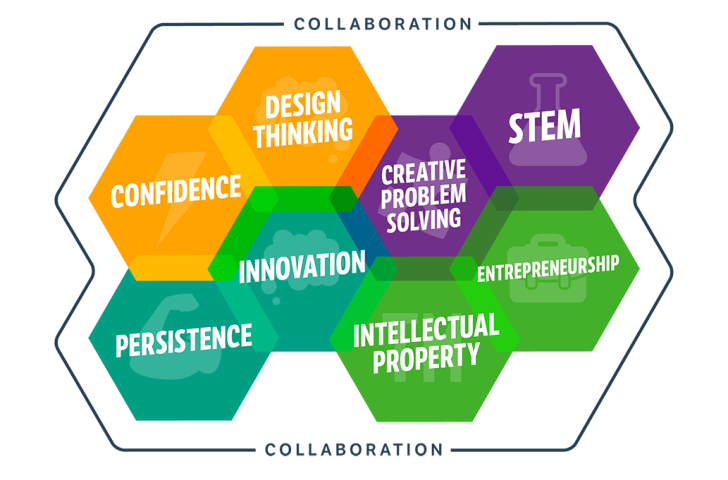
- Design Thinking: Design thinking helps students to identify challenges and solve problems. By focusing on the people who will use the inventions they create, children can apply critical thinking to design solutions that meet their users’ needs.
- Confidence: Students build confidence as they turn their ideas into reality and begin to see themselves as capable creators.
- Creative Problem Solving: Students learn to use critical and creative thinking to develop innovative solutions, preparing them for both everyday problems and complex challenges.
- STEM: By engaging in STEM, children will be better equipped to apply their ingenuity, pursue in-demand careers and make their mark on our rapidly evolving world.
- Persistence: Applying a “create, test and retest” approach, students build persistence to reach their goals and resilience to recover from failure and overcome obstacles.
- Innovation: Students engage in hands-on challenges to solve real-world issues, dream up new inventions and improve upon existing ones to push society forward.
- Intellectual Property: Students discover the power and purpose of intellectual property, prepare to protect their rights as creators and recognize the value of their own ideas.
- Entrepreneurship: Students practice creative risk taking as they build business skills, learn how to bring inventions to market and emerge as leaders who follow their dreams.
- Collaboration: Students receive peer feedback, build upon each other’s ideas to find solutions and gain important experience in both sharing their ideas and listening to unique perspectives as they practice collaboration.
Bring Invention Education to Students Today
Are you looking for ways to spark critical thinking through active learning experiences? Bring invention education to your students today.