Who Invented the Microwave?
Inductee StoriesDate May 19, 2026
Est. Reading Time 4 mins
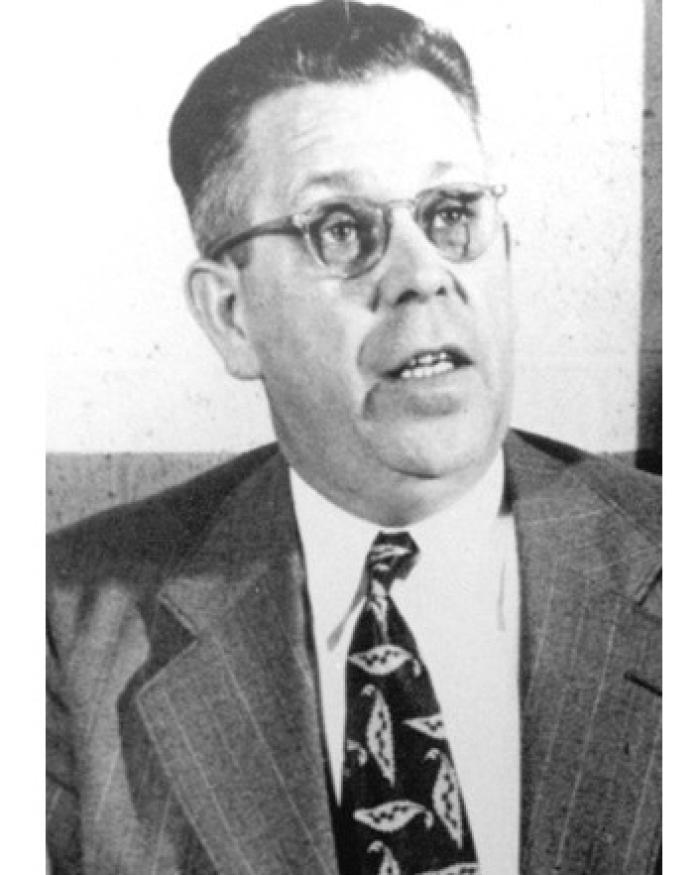
For decades, the microwave oven has been a standard kitchen appliance, and many of us use one every day. But how many of us know who invented the microwave? The answer is not just a bit of knowledge that might come in handy during a trivia tournament — it’s a unique story that demonstrates the value of American ingenuity. It’s the story of National Inventors Hall of Fame® Inductee Percy Spencer.
Challenges and Motivations
Spencer was born in Howland, Maine, in 1894. Before he’d turned 2 years old, his father died, and he was sent to live with his aunt and uncle. After his uncle also died, Spencer left school at just 12 years old and began working at a spool mill to help support his family. At 17, he got a job installing electricity at a paper mill, when electricity was only just beginning to be installed in rural areas.
Spencer wrote that in 1912, after the sinking of the Titanic, “the heroism of the wireless operator inspired young Spencer to join the Navy where there was an opportunity to learn wireless telegraphy.” He joined the U.S. Navy at age 18 as a radio operator, and while working, he also used textbooks to teach himself subjects including calculus and physics.
Following his naval service, Spencer took a position with the Wireless Specialty Apparatus Co. in Boston. Following World War I, he became a civilian radio aide in the Navy’s Radio Division of the Bureau of Steam Engineering, and in 1921, he began working for the Submarine Signal Co.
In 1925, Spencer joined the American Appliance Co., which would later become Raytheon Co. He would continue to work for Raytheon for 39 years before his retirement in 1964.
Determination and Innovation
At Raytheon, Spencer applied his expertise in the radio and vacuum tubes department. During World War II, he and his colleagues developed radar equipment including the compact cavity magnetron. A high-powered vacuum tube that generates microwaves (a form of electromagnetic radiation), the magnetron was used to detect enemy planes and submarines.
In 1941, when magnetrons were being produced at a rate of just 17 per day, Spencer was determined to create a simpler magnetron that could be mass produced. His efforts resulted in a magnetron that replaced precision copper bars with lamina and replaced soldered internal wires with a simple solid ring. These improvements and others allowed Raytheon to produce 2,600 magnetrons per day.
In recognition of Spencer’s innovation, which advanced the U.S. military’s technological capabilities, the Navy presented him with the Distinguished Public Service Award.
Surprises and Solutions
How did Spencer’s work with magnetrons lead him to invent the microwave oven? It began one day in the Raytheon laboratories when Spencer approached a magnetron and was surprised as he realized that a candy bar in his pocket had begun to melt.
Wanting to understand what had caused his candy bar to melt, Spencer began to experiment with unpopped popcorn. When he held the bag next to the magnetron, he saw the kernels pop. Any time you make popcorn in a microwave, you’re recreating the process that led Spencer toward his invention.
Seeing the potential in this discovery, Spencer and the team at Raytheon developed the microwave oven to be used for cooking, and the company filed for a patent in 1945. The patent was issued in 1950.
The first microwave to hit the market was called the “Radarange.” Marketed in 1947, it could boil water and reheat food much faster than a range or an oven. However, this early model did not look like today’s microwaves. It was about 6 feet tall and weighed 750 pounds! It also was very costly. At the time, only restaurants began buying and using these microwaves.
It wasn’t until about 20 years later that a microwave designed for home use became available. After acquiring Amana Refrigeration Inc. in 1965, Raytheon was able to sell microwaves on a much larger scale. As more and more people bought microwaves for their kitchens, companies also began to produce prepackaged foods that were specifically made to be prepared using a microwave. Today, about 90% of American homes have a microwave.
Before retiring, Spencer became senior vice president and a member of the board of directors at Raytheon. He earned about 150 patents during his career. In 1959, Raytheon opened the Spencer Laboratory, named for the inventor and dedicated to the field of microwave tube technology. Spencer received honorary doctorates in science from the University of Massachusetts, Nasson College and the University of Maine.
Meet More Impactful Inventors
Spencer is one of more than 650 inventors who have been inducted into the National Inventors Hall of Fame so far. To learn more of their stories, keep exploring our website, and to tell us who should become the next Inductee, make a nomination!