STEM Activity: Design a Mechanical Hand
STEM ActivitiesDate October 2, 2026
Est. Reading Time 3 mins
Place your hand on a tabletop and watch every little motion needed to pick up your favorite piece of candy from a bowl. While grabbing a piece of candy may seem like a simple act, you might notice just how many micro movements are involved in this task!
What if you could streamline your pathway to sweets by designing a hands-type device that picks up candy for you? Unleash your inner engineer as you design and build a mechanical hand and test its capabilities! Will it pick up a piece or an entire handful of candy?
Materials Needed:
- Cardboard
- Markers
- Scissors
- Straws (1-2)
- String (about 4 feet)
- Tape
Instructions:
- Trace your wrist and hand on cardboard and cut out the tracing.
- Open and close your own hand to make a fist. Notice where your fingers bend. Draw lines across each cardboard finger approximately where your own fingers bend, and then fold along those lines.
- Cut five small pieces (1-2 inches) of a straw and tape them between the bends along each finger.
- Cut five pieces of string, each about 10 inches long.
- Tape one end of each string to a cardboard fingertip.
- Feed each string through the straw pieces from the fingertip to the wrist.
- Allow the other end of each string to hang below the wrist portion of the cardboard.
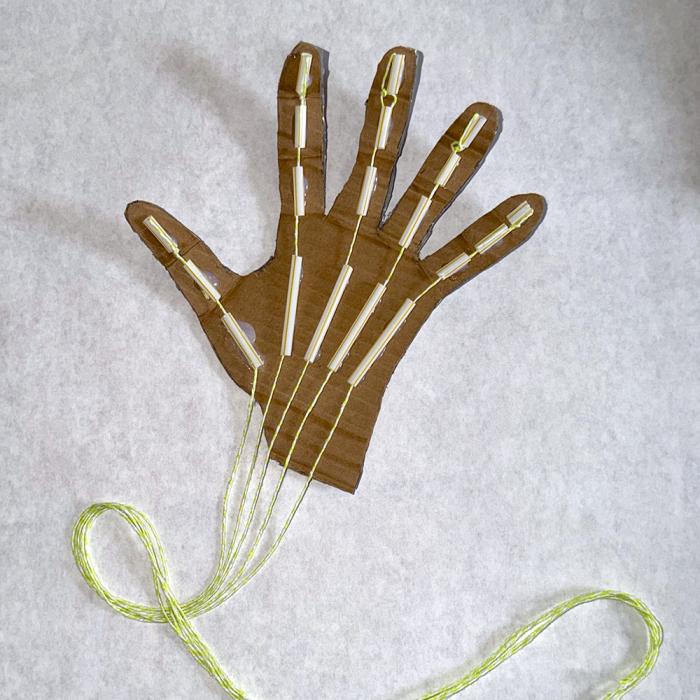
- Pull the strings to bend the cardboard fingers. What happens when you pull the strings at the same time?
- Test your mechanical hand by trying to pick up a piece of candy, then adjust your design and keep testing. How does pulling harder or softer on the strings change how your mechanical hand moves?
Bonus: Continue exploring how your hand can move. Try adjusting your design to make different motions, like a thumbs-up or a pointing index finger. Can you pick up more than just one piece of candy? Try testing your mechanical hand with different objects, like coins or flowers, to see how design changes and object details affect performance.
What Are We Discovering?
As you use your model, notice how the fingers move. Did you know that your fingers do not contain muscles? Instead, muscles in your forearm pull on tendons. Tendons are strong, flexible structures connected to the bones in your fingers. When a muscle contracts, it can pull on a tendon and cause a finger to bend. In your mechanical hand, the strings act like tendons! Pulling a string changes the position of a finger, helping to model how movement can happen in your hand.
As you experiment with your mechanical hand, you also can find connections in the work of National Inventors Hall of Fame® Inductee George Devol. While he was working on magnetic recording technology, Devol realized the value of factory automation. In 1954, he filed a patent for a robotic arm that could move with 6 degrees of freedom and store step-by-step digital commands on a drum or other medium. His invention would become the world’s first industrial robot. Today, engineers continue to design tools like robotic arms used in surgery. These arms can grasp and move with precision. By studying how movement works in the human body and in nature, inventors can create technologies that improve how people interact with the world.
Keep Exploring STEM
There is always something new to discover in the world of STEM. To find even more hands-on STEM activities, sign up to receive monthly emails for brand-new challenges and creative ideas to try!