Building Early Math Skills Through Play
Educator InsightsDate August 6, 2026
Est. Reading Time 3 mins
Math is more than finding the right answer – young learners quickly discover that numbers tell stories. As children engage in play that involves early math concepts, they begin building a positive relationship with numbers and learn to see math as relevant and approachable.
With play as a vehicle for building early numeracy skills, educators can facilitate moments of joyful learning that lead to STEM confidence and student achievement.
Counting
As children achieve important milestones like number recognition, counting is a foundational skill that indicates early numeracy. From colorful blocks to playful melodies, interactive experiences that prompt students to count helps put learning into context. Working in tandem with their development over time, pretend play continues to be an essential learning tool for children as they grow older.
Counting exercises easily can be integrated into pretend play scenarios. For instance, creating a classroom storefront is an enriching, play-based strategy that empowers students to work together. As each child takes a turn behind the cash register, they can count out change for their customers.
Spatial Reasoning
Hands-on creation is the perfect pathway for young learners to build context around math. Whether young learners benefit from the art of tinkering or the impact of self-led discoveries, hands-on experiences help students visualize theoretical concepts and develop spatial reasoning skills.
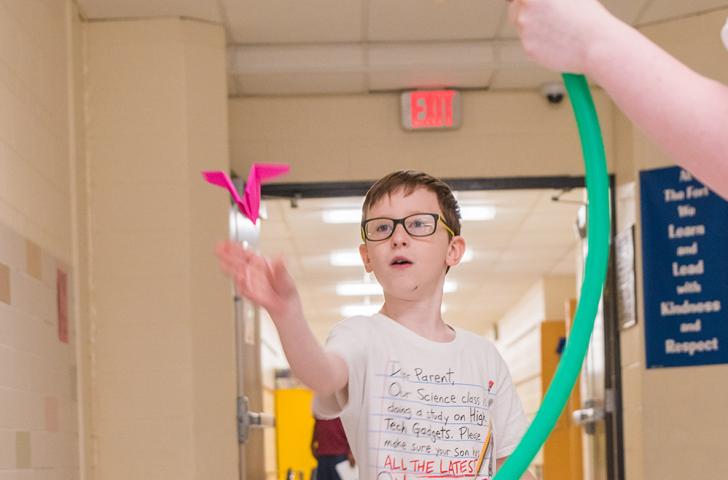
As students brainstorm, experiment and begin to manipulate materials, a child’s first exposure to geometry might start with identifying and describing shapes during a game of playground engineers. As classmates design an obstacle course filled with chalk and cones to create shapes and pathways, students can explore measurement, direction and position to strengthen their spatial awareness by experimenting with paper airplanes. For an indoor activity, consider prompting students to dive into a hands-on packing puzzle.
Problem Solving
What if every student lit up when they were given a challenge? Play-based strategies for engaging students with STEM puts math at the forefront of problem solving. As learners begin to see math as a tool to uncover a mystery or bring an idea to life, their autonomy drives positive associations with finding solutions.
By transforming math from an abstract subject into a practical skill set, students can explore probability during a game design challenge or discover engineering principles during a build-a-bridge challenge, uncovering how math guides the creation of a sturdy structure.
Math Language
Whether they are measuring, comparing or estimating, the everyday relevance of math can empower students to develop an early math vocabulary and support early numeracy. Connecting language to these early experiences also can enhance mathematical understanding.
As educators guide students to build a math-oriented lexicon, project-based STEM experiences spark organic, mathematical thinking. From creating a math “word wall” to evaluating which building is tallest, creating daily scenarios where math language is used can make a lasting impact.
Identifying Patterns
Math has its own unique language. As young learners begin to use algebraic thinking to solve problems, play-based experiences can strengthen their analytical skills and keep those thoughts in motion.
Consider putting forth hands-on experiences where students can make patterned artwork or create sequenced bead patterns with DIY bracelets. These experiences combine foundational math with development of fine-motor skills for enriching, holistic learning experiences.
Engage Learners
Looking for more ways to engage young learners? Keep exploring our blog for more ideas and actionable insights to implement in your classroom.